

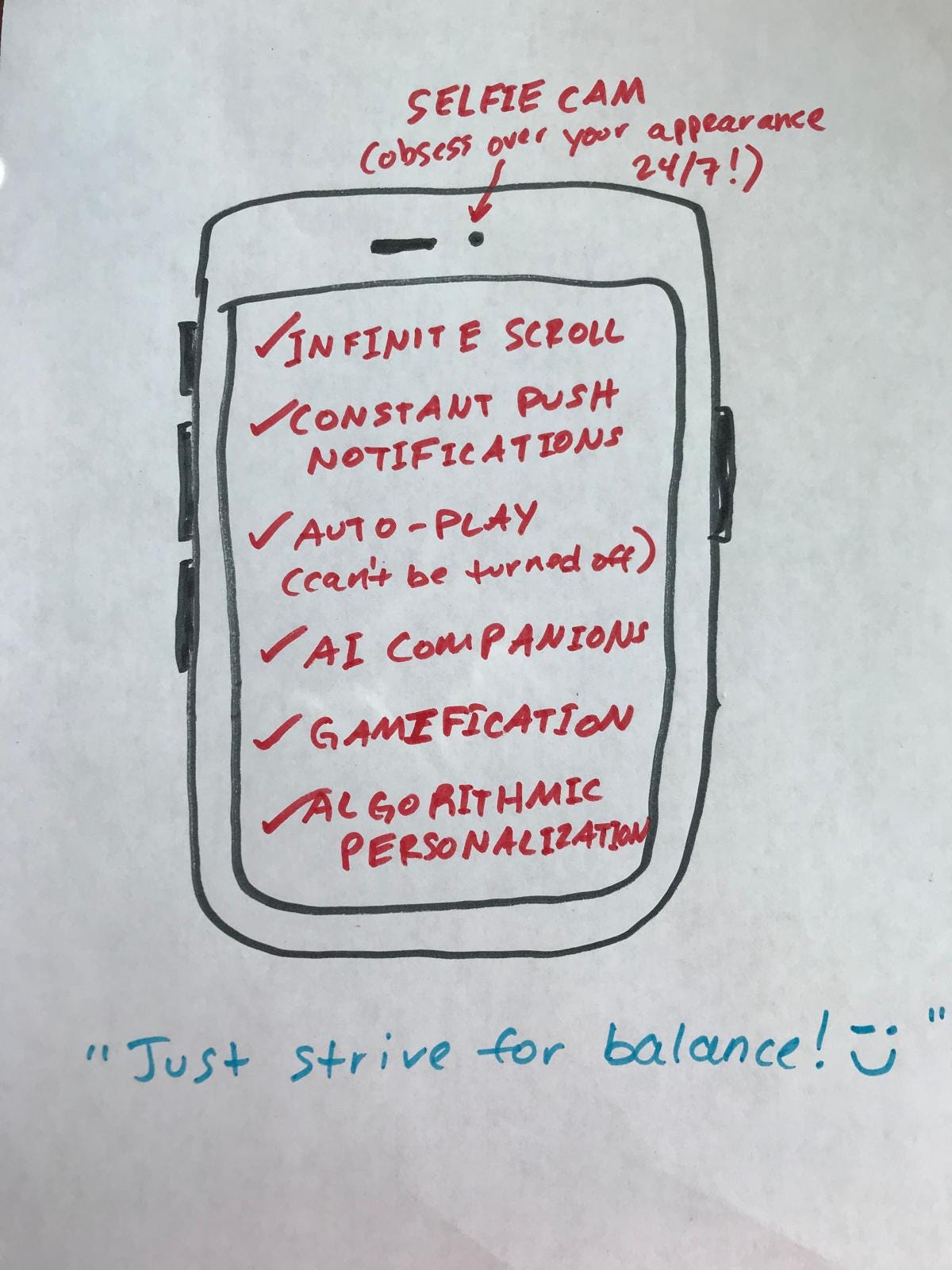
One of the most common arguments for giving kids smartphones is that we need to teach them “responsible use.” If kids don’t have access to this technology, the argument goes, they’ll never learn how to use it properly. But what does responsible use look like, and is it even possible?
In the U.S., one in two kids with a phone is addicted to it, and nearly half of all teenagers say they are online “almost constantly.” Whatever responsible use is, it’s not this.
Kids struggle to use smartphones responsibly not because parents are doing a bad job teaching them how, but because the game is rigged. Addictive use is baked into the design of smartphones and social media apps. This is a fact, just like it is a fact that nicotine is an ingredient in cigarettes. Anyone who has ever opened their phone to check the weather and looked up after an hour of reels probably knows this intuitively, and if there are still doubts, the makers of these products have told us themselves.
Shamefully, the role of Big Tech in manipulating children’s behavior online through persuasive design is often downplayed in discussions about responsible use, if it’s mentioned at all. That is because the tech industry controls the narrative. I once sat through a 45-minute digital wellness presentation for parents at an elementary school that did not mention the word “algorithm” a single time. The event was hosted by the National PTA (which, at the time, had sponsorships with Meta and TikTok, among other tech companies) and paid for by AT&T. Parents who shared grave concerns about their children’s compulsive screen use were given trite advice like “strive for balance!”—but no information on the manipulative tactics Big Tech uses to keep kids scrolling. The National PTA brings industry-funded digital wellness presentations to many schools around the country every year.
The truth you’ll never hear at these talks is that when we ask our children to use smartphones responsibly, we are asking them to do the impossible. We’ve had over a decade to teach kids how to do this and it’s clearly not working, and it will never work as long as Big Tech optimizes its products for engagement rather than safety.
None of this is the fault of parents, but parents do have a responsibility. We are raising children in a world where powerful, predatory corporations compete for their attention every waking moment. To flourish, our kids must build the habit of being present. We can help them by modeling this habit ourselves and by delaying their access to persuasively designed technology like smartphones, social media, and generative AI as long as possible.
Some worry that kids without early access will be at a disadvantage in a future that seems certain to be even more tech-saturated than the present. But the opposite is true. Limiting access is a critical part of the education. It gives kids space to develop the skill of being intentional with their attention. They need to read books, make art, play, and learn without constant digital distraction. They need to know what sustained focus, or flow state, feels like in their body. They need to socialize face-to-face, without a phone to hide behind at the first lull in the conversation. They need to experience solitude to discover that being alone with your thoughts isn’t something to run from, but a crucial steppingstone toward creativity. When we give them a smartphone, we hijack so many of these opportunities.
Saying no to the smartphone means saying yes to something much better: the fullness of an embodied life, with all its beauty and all its slings and arrows. This way of living is what builds foundational skills like resilience, emotional intelligence, and creativity in a child. It’s what will empower our children to be the masters of their own attention as they enter adulthood.
Going against the grain in a tech-obsessed world can feel daunting, but it’s easier when we band together. Share your concerns about technology with one other parent and see where the conversation goes. Make screen-free gatherings the norm in your home. Encourage free play. Tolerate your child’s boredom. Start a landline club. Be mindful of the tech habits you’re modeling. And keep saying no to the smartphone, for as long as possible.
Note: A version of this piece was published last year on the Smartphone Free Childhood US blog. It is as timely as ever so I am sharing it again here.
I could not agree more with all of this. What tech companies want for our children has never been aligned with what we want. They are simply business model, and a very successful one. The problem comes when we believe their narrative that they are trying to do something good for humanity. I have just written a substack about our new landline - it's been incredibly successful for our daughter and her friends!