

It’s January 2nd and everyone is beyond done with New Year’s resolutions content. I sympathize. But, per usual, I failed to optimize myself and did not get this post out in a timely fashion, so you’ll have to bear with me.
The good news is the resolution I’m asking you to consider is way easier than finishing War and Peace, eliminating plastics from your life, or getting through the 108 sun salutations (not that those aren’t worth taking a stab at!). This resolution is the low hanging fruit of a better life for you and your whole family. It’s one you can achieve in under a minute and instantly start reaping the benefits.
So, here it is: Let 2026 be the year you quit Facebook and/or Instagram for good. Not a detox, a clean break. Walk away and never look back.
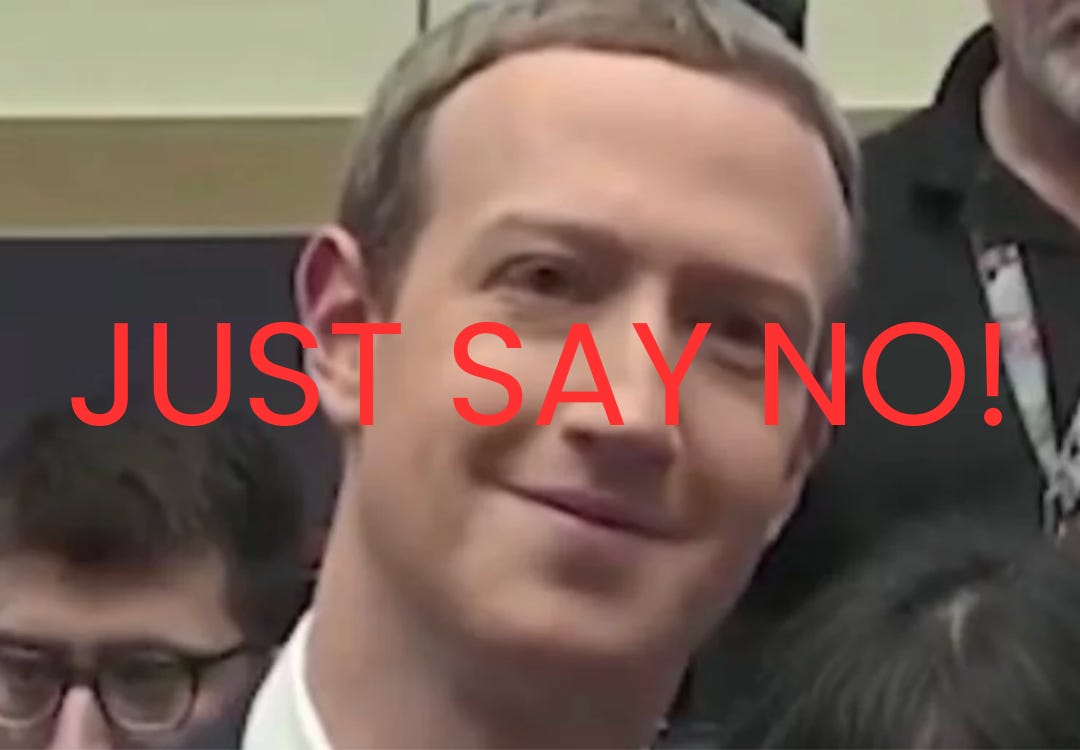
Here are five reasons why you should refuse to line the pockets of Mark Zuckerberg with your swipes, likes, and comments for one second longer:
1. You are being exploited.
We often talk about how social media companies exploit the vulnerabilities of children for profit, but adults are not immune. Every time you open Facebook or Instagram, you are handing your precious attention over to a trillion-dollar company that does not have your best interests at heart. You would be better off giving that attention to a blank wall in your home, and you’d probably feel better afterward as well.
It is not an accident when you open your phone to check the time and find yourself involuntarily swiping over to Facebook and Instagram a moment later—dozens of times a day. It’s not a fluke when you’re out in the world enjoying the moment and then suddenly feel compelled to document that moment for your virtual audience, thereby ruining the moment. All that time spent scrolling and thinking about scrolling adds up—adds up to a life. A life that Meta is monetizing. Your life. This is happening not because you’re weak, but because the algorithms that keep drawing you in were engineered by some of the most sophisticated brain scientists in the world to capture your attention and keep you hooked.
But “technology is neutral” and “it’s how we use it that counts”!
Sure, keep telling yourself that. Keep beating yourself up when your willpower isn’t enough to resist the pull of the ‘gram and when “digital wellness” remains a phantom.
OR…you could accept that the game is rigged and that most people have as good a chance at achieving “balance” on social media as a toddler let loose in a candy store. And you could free yourself by opting out of the entire ruse.
2. Meta is an evil company.
From sparking a genocide in Myanmar to targeting teen girls with beauty ads the moment they delete a selfie on Instagram (and bragging about this ability to prospective advertisers) to assigning teenagers a “lifetime value” of $270, there is clearly no low Meta won’t stoop to its relentless pursuit of growth and profit. But the one that pissed me off the most this year was when Meta’s higher-ups got together and decided it was acceptable to let chatbots engage in sexy talk with children. That’s right. Per Reuters, Meta executives, including the company’s CHIEF ETHICIST, were debating where to draw the line regarding appropriate chatbot/child interactions, and this is where they landed:

Big Tech has a terrible track record of rushing to release products before they’ve undergone adequate safety testing. Kids and teens have died from resulting harms. But that’s not what happened here. This is worse. Meta’s chatbots were programmed to sext with minors not because of a safety oversight, but because people at the top of the company made the conscious decision to allow it. Why would they do that though? One word: engagement. Eyes on the screen = money in the bank for Zuck & co., and nothing sells like manufactured intimacy.
Parents were rightly outraged when Reuters broke this story a few months ago. My question is: what are we going to do about it? What message are we sending our children when we condemn Meta for sexually abusing children (because that’s what it is when an adult talks to a minor in a sexually explicit or suggestive way) but then carry on using Facebook and Instagram ourselves?
The time to take a bold stance against this company by opting completely the heck out of their platforms is NOW.
Related…
3. Actions speak louder than words, and our kids are watching.
We can tell our children that their life will be richer without the constant social comparison that is the bread and butter of social media platforms. We can tell them they are valued for who they are, not their accomplishments. But when they see us curating our own highlight reel online, what will they believe?
We can tell them that quality matters more than quantity, and that one real friendship is more valuable than a million Instagram followers. But when they see us checking our own follower count, what will they believe?
We can say that being present is what matters most. But when they see us breaking away from the present moment to check our notifications dozens of times a day, what will they believe?
If we want our kids to believe that life should be lived, not scrolled, then we need to practice what we preach, and getting rid of Facebook & Instagram is the perfect place to start.
4. You need these platforms less than you think.
I’ve talked to many parents who feel icky about Facebook and Instagram but still maintain accounts because they worry they’ll be isolated without them. I understand and stuck with Meta much longer than I wanted to (like years longer) because of this fear. I thought I needed my local parenting Facebook groups to stay connected and my Instagram feed to remain “in the know” about local happenings. FALSE. Turns out most of the “connections” I’d made on social media were artificial and transient, which is not anyone’s fault but simply due to the nature of the apps (the medium is the message!). If anything, I feel less isolated and more connected in my hometown since leaving those platforms.
5. Any benefits of social media are not worth the cost.
Like Boromir with the Ring of Power, I used to believe I could use Facebook and Instagram “for good”—namely to support my advocacy about kids and screens. I’ve changed my mind. Meta did not come out of nowhere. It emerged from a toxic cultural mindset that increasingly values quantity over quality, branding over authenticity, optimization over organic processes, convenience over healthy friction, and growth for the sake of growth alone (which, as Paul Kingsnorth rightly points out, is just another way of saying “cancer”). You cannot play the social media game without accepting these values on some level, and I no longer think it’s worth it.
I understand many people feel they have to use social media for professional reasons and I’m not judging—just asking you to think outside the box. What would happen if you opted out? What other ways could you promote yourself besides Facebook and Instagram?
You don’t have to go it alone.
Looking for solidarity and support in ditching social media? Check out these organizations that are boldly rejecting social media use as a foregone conclusion for humans from all walks of life, from tweens and teens to college students, working professionals, stay-at-home parents, retirees, and everyone in between.
Appstinence (Gen Z-led)
And props to Smartphone Free Childhood US, which will soon be launching an off-Meta forum for like-minded parents to connect with each other!
I quit Facebook over 8 years ago and quit Instagram (the last app I was on) over 8 months ago. I do not miss social media at all. I do not miss the misinformation and relentless advertising. I do not miss the virtual "friends" that I no longer hear from since the people I am truly friends with are all in my life in a real way - in the face-to-face world. It is strange when you realize that a lot of people spend their days with their bodies in the material world, but their minds living somewhere else out there in the ether.
Never, not for a moment, have I regretted ditching Facebook & Instagram. In fact, I moved to an entirely new state and have made tons of great, meaningful friendships all without any social media accounts.